
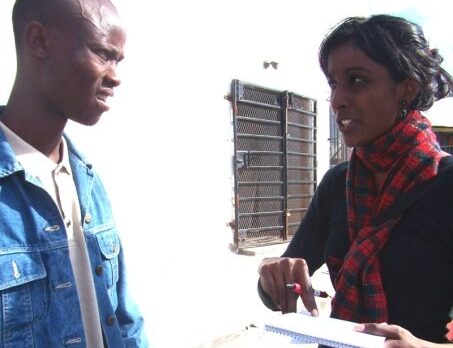
This photo was taken in 2008. I was a young reporter, notebook in hand, in Khayelitsha, trying to make sense of the first wave of xenophobic violence to rip through this country.
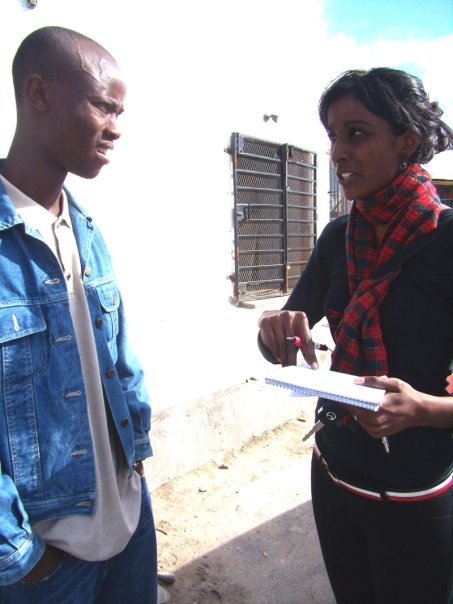
I was profoundly affected. I watched Somalian mothers in tents, cradling their babies in disbelief. Spoke to Ethiopian men, almost crying from the shock and pain of it all. I thought: We will never let this happen again.
I remember thinking: We will never let this happen again.
Yet here we are. Eighteen years later, I am watching the same fires, literal and figurative, and the same dangerous lies spreading faster than ever, turbocharged by social media and amplified by politicians who should know better.
So let me say the thing that keeps getting lost in the noise. The numbers do not support the narrative.
Immigrants, documented and undocumented combined, make up somewhere between three and four million people, according to a GroundUp report. That is about 5% of our population. (I keep being asked where that figure comes from; more info at the bottom of this piece.)
For context, immigrants make up more than 20% of the population in countries like Australia and Canada, and between 10% and 20% in the United States and across Europe. Our 5% is small by any comparison.
So the idea that 5% of the country is responsible for our crime, our unemployment and our collapsing healthcare is not just wrong. It is mathematically absurd.
Look at who the Zondo and Madlanga Commissions have actually implicated. Look at the rape statistics: about 120 women raped every day in this country, and studies showing that roughly a third of South African men admit to having committed rape. Are we really going to blame foreigners for that?
The same pattern holds everywhere you look. Most non-South Africans in our prisons are there for breaking immigration laws, not violent crime. Only 1.8% of learners in our schools are foreign, and the Department of Basic Education has said plainly that they are not the reason the system is buckling. Our hospitals lose more to corruption and irregular spending every year than it would cost to treat every immigrant in the country. The township economy that March and March claims is being “hijacked” is not shrinking. It is most likely growing.
If every undocumented immigrant left tomorrow, your local public hospital would still be broken. Not because of the person standing ahead of you in the queue, but because of corruption, mismanagement and decades of underfunding that have nothing to do with them.
This is why March and March’s 30 June deadline frightens me. It is not a peaceful protest. It is a dog whistle. We have already seen what follows: people forced from their homes, shops looted, houses burnt, and people killed. The movement borrows its language directly from Donald Trump, talking about an “invasion” and a sovereignty that must be “protected.” We have seen where that language leads.
And the media houses and political figures who treat this as legitimate activism are complicit in what it is actually designed to trigger.
I started explain.co.za because I believe that access to accurate, contextual information is not a nice-to-have. It is the foundation of a functioning democracy. A democracy that lets dangerous misinformation go unchallenged, that lets real economic despair be weaponised against the most vulnerable people in the country, is one that is putting itself at serious risk.
We have covered this crisis extensively at explain.co.za, and we will keep doing so. Because we owe it to each other to do better.
A note on the numbers: where the 5% comes from
The roughly 4 million figure comes from the International Organization for Migration and UN population data, compiled in the Helen Suzman Foundation’s migration brief, which is the source GroundUp drew on. That estimate already tries to fold in Stats SA’s numbers for undocumented migration, so the undocumented are not simply left out of it.
Against a current population of around 63 million, three to four million people works out to roughly 5 to 6%. The HSF brief itself put it closer to 7% in 2017, when it divided 4 million by the smaller population of the time. The percentage moves with the year and the population base, but it stays a small minority either way.
Why an estimate and not a hard number? Because the Department of Home Affairs has not published documented immigration data since 2015, and undocumented migration is by its nature very difficult to measure. Surveys undercount too, because people who are undocumented understandably avoid identifying themselves as foreign-born. So nobody, including the government, has an exact figure. That gap is itself a failure of the state, not evidence of an invasion.
And the bigger picture holds whichever number you reach for. Even at the upper end of credible estimates, the foreign-born share sits well under 10%. In Canada and Australia it is more than 20%. We are talking about a small minority being blamed for problems that are overwhelmingly homegrown.